Answers that show their checks
Every number traces to code that ran.

Mizura is a statistical AI agent. Plan the method, run Python on your data, and trace every result to its code.
Available for
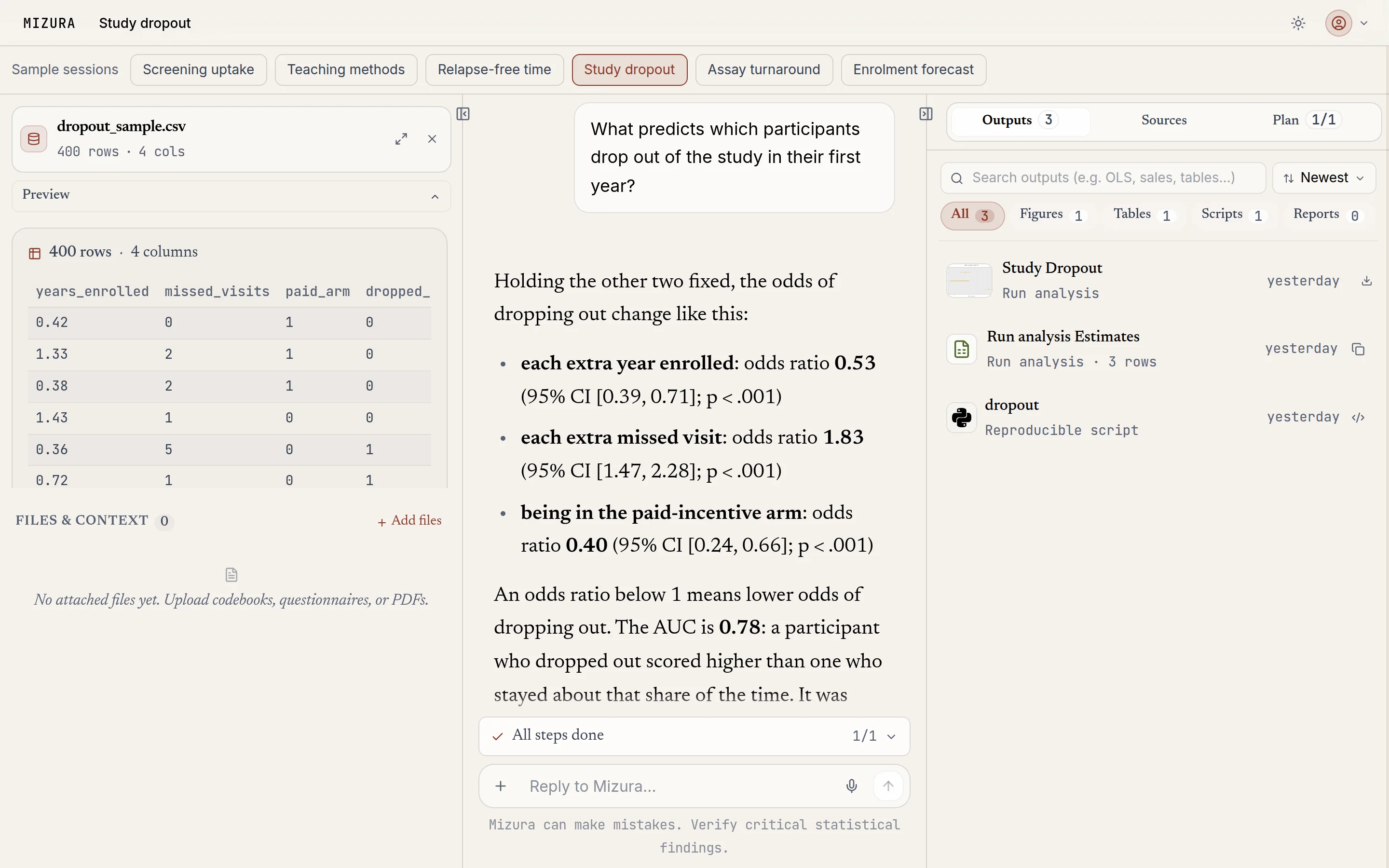
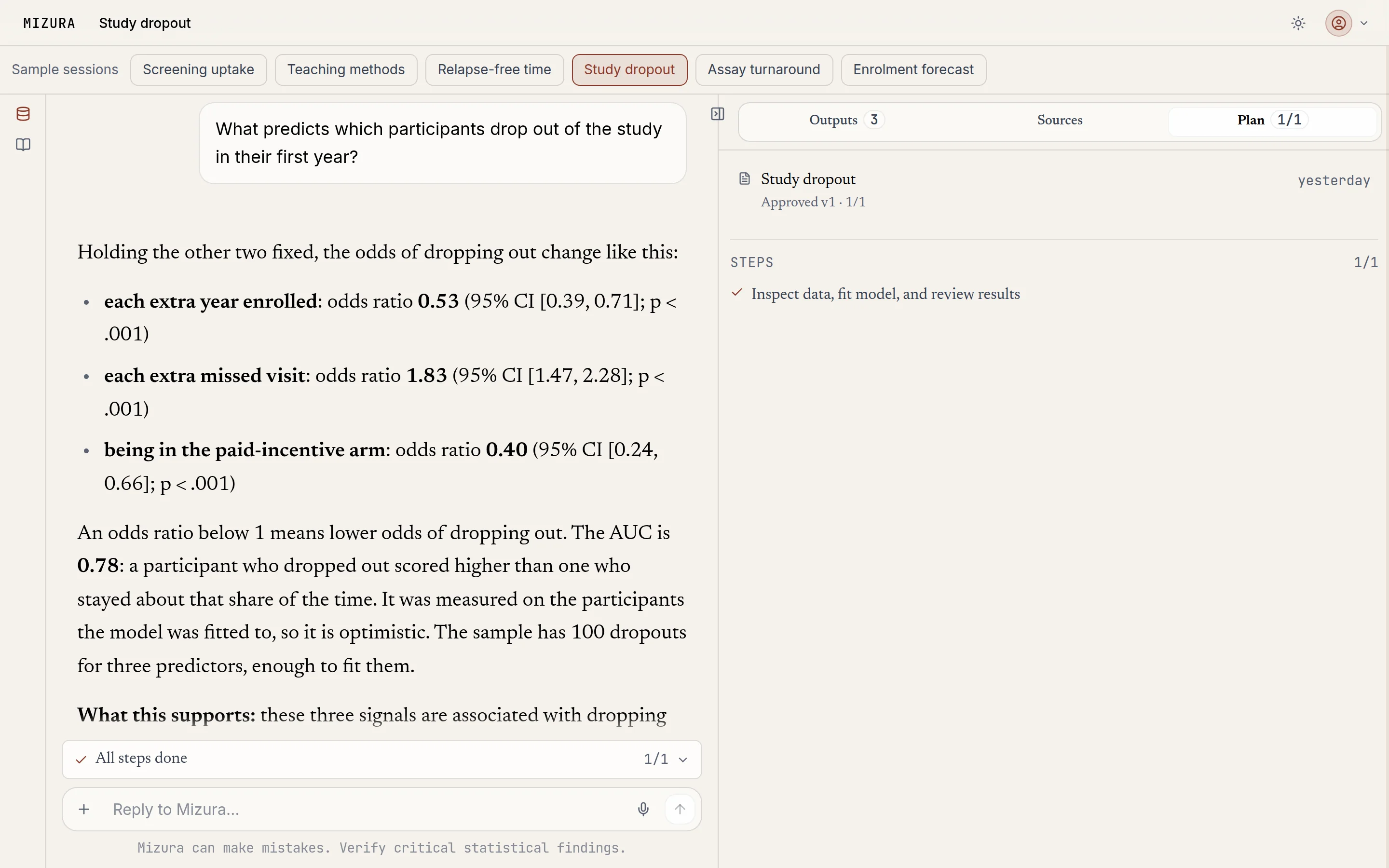
X = sm.add_constant(frame[predictors])
fit = sm.Logit(frame["dropped_out"], X).fit(disp=False)
odds, ci = np.exp(fit.params), np.exp(fit.conf_int())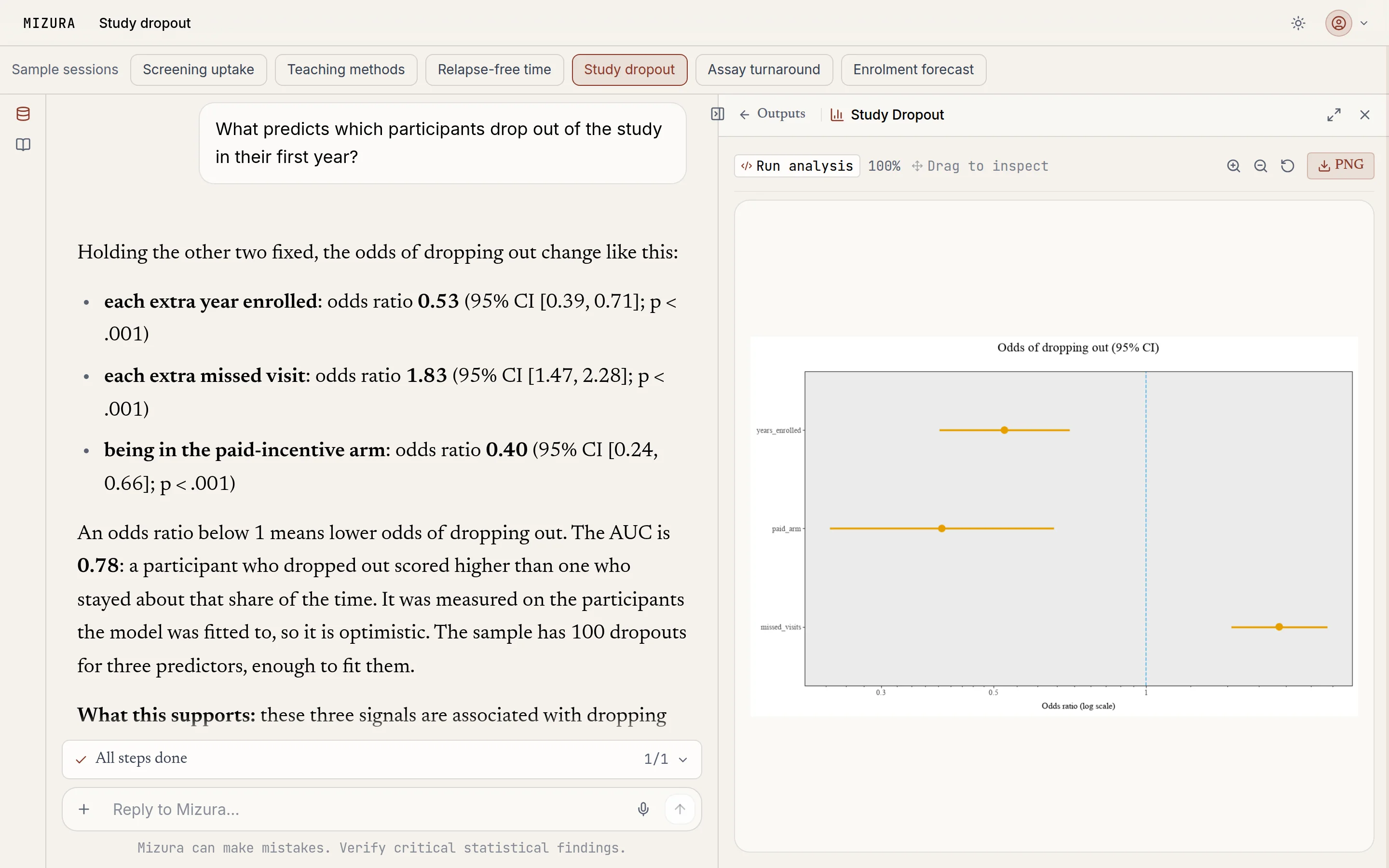
If it isn’t in the output, Mizura sends the answer back.
Every number traces to code that ran.
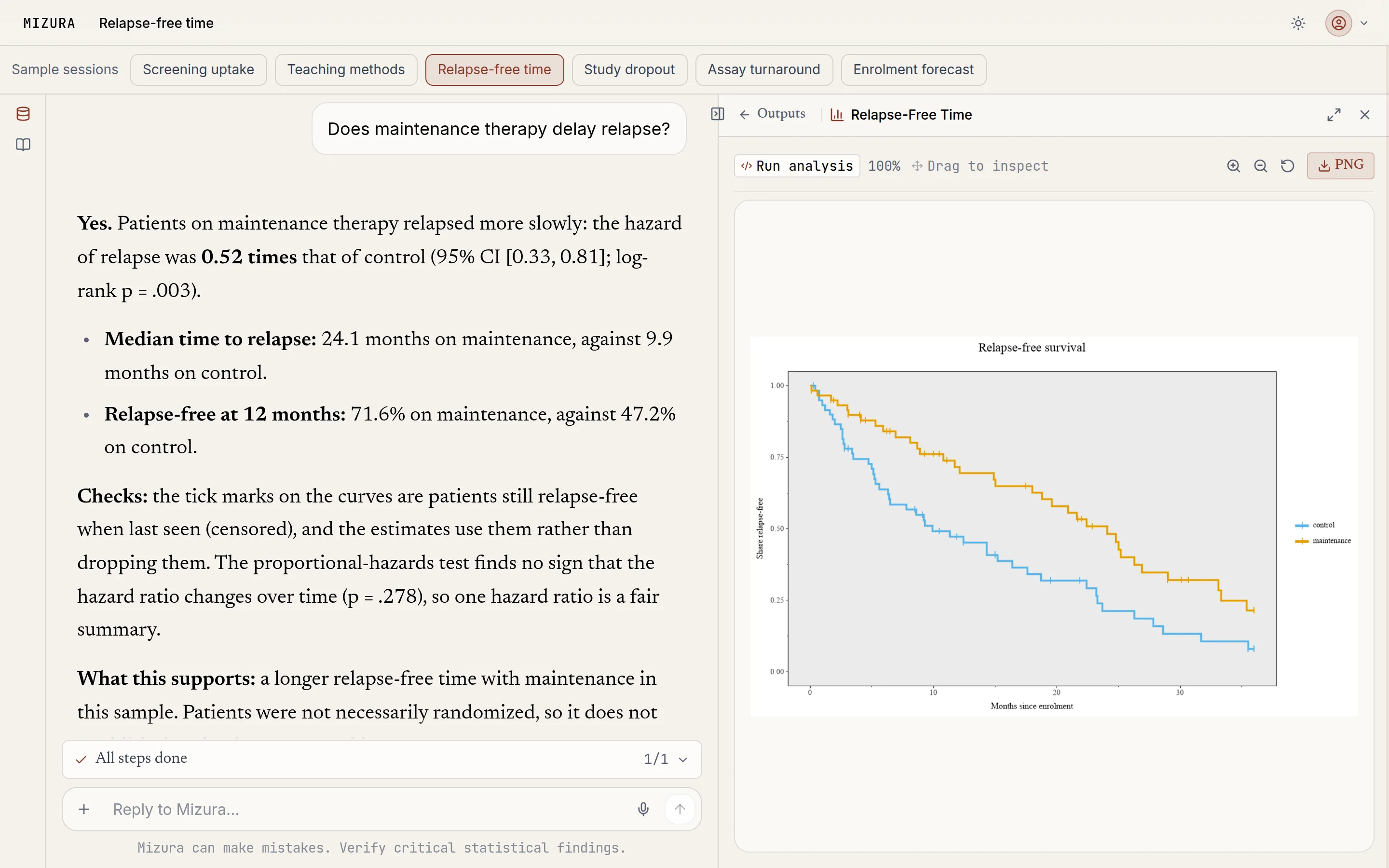
Zoom, drag and export.
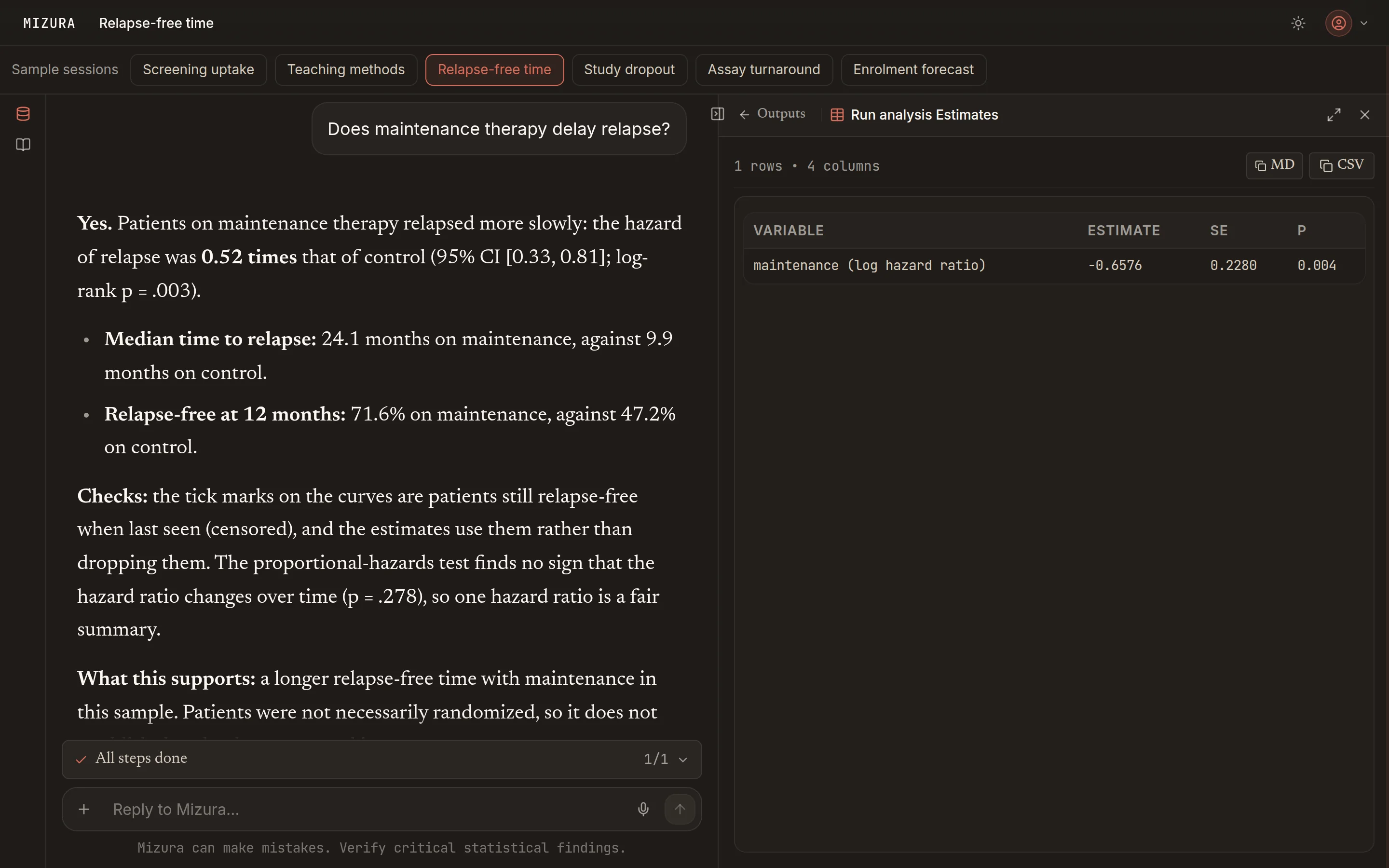
Copy as Markdown or CSV.
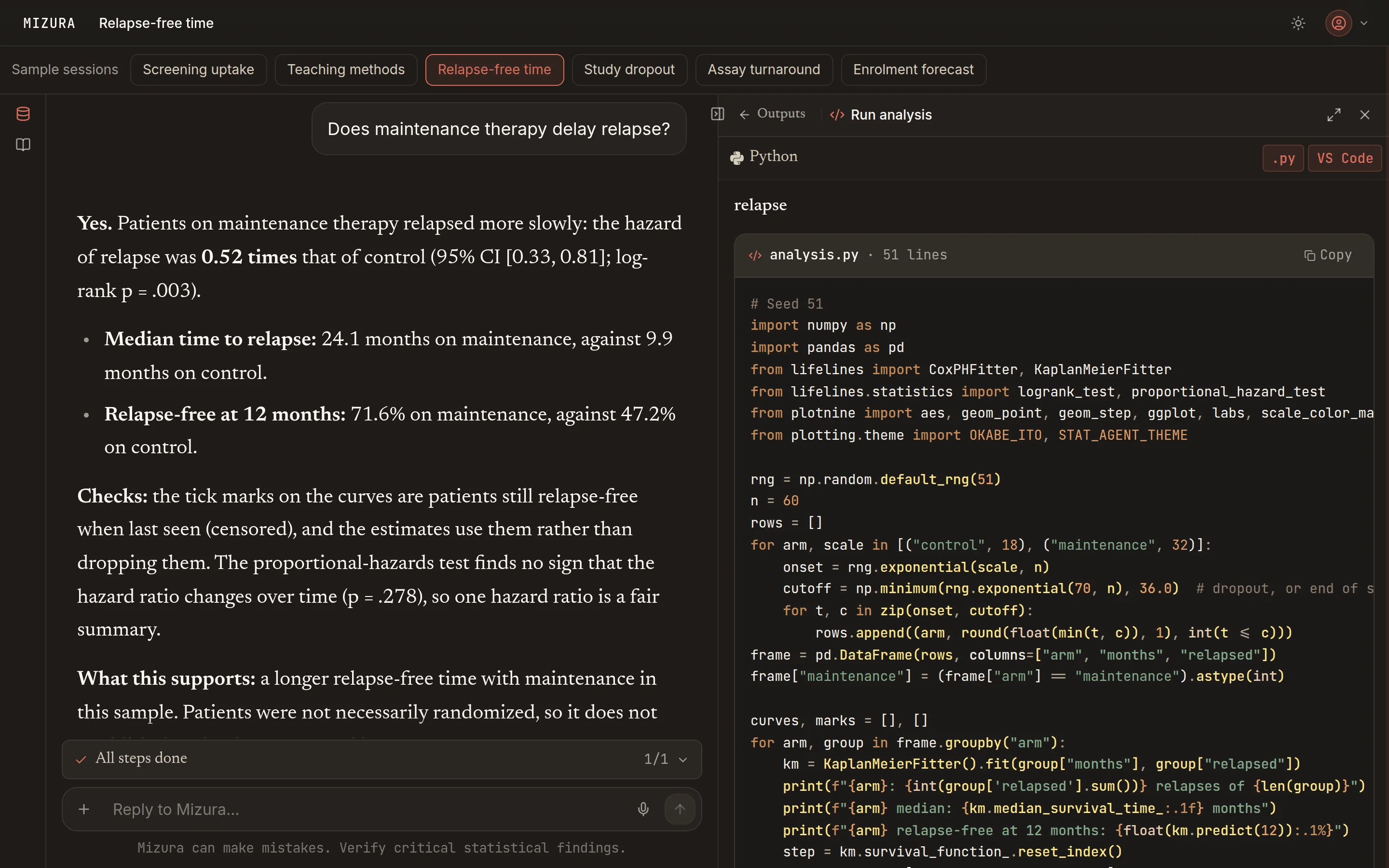
The exact script, as .py or in VS Code.
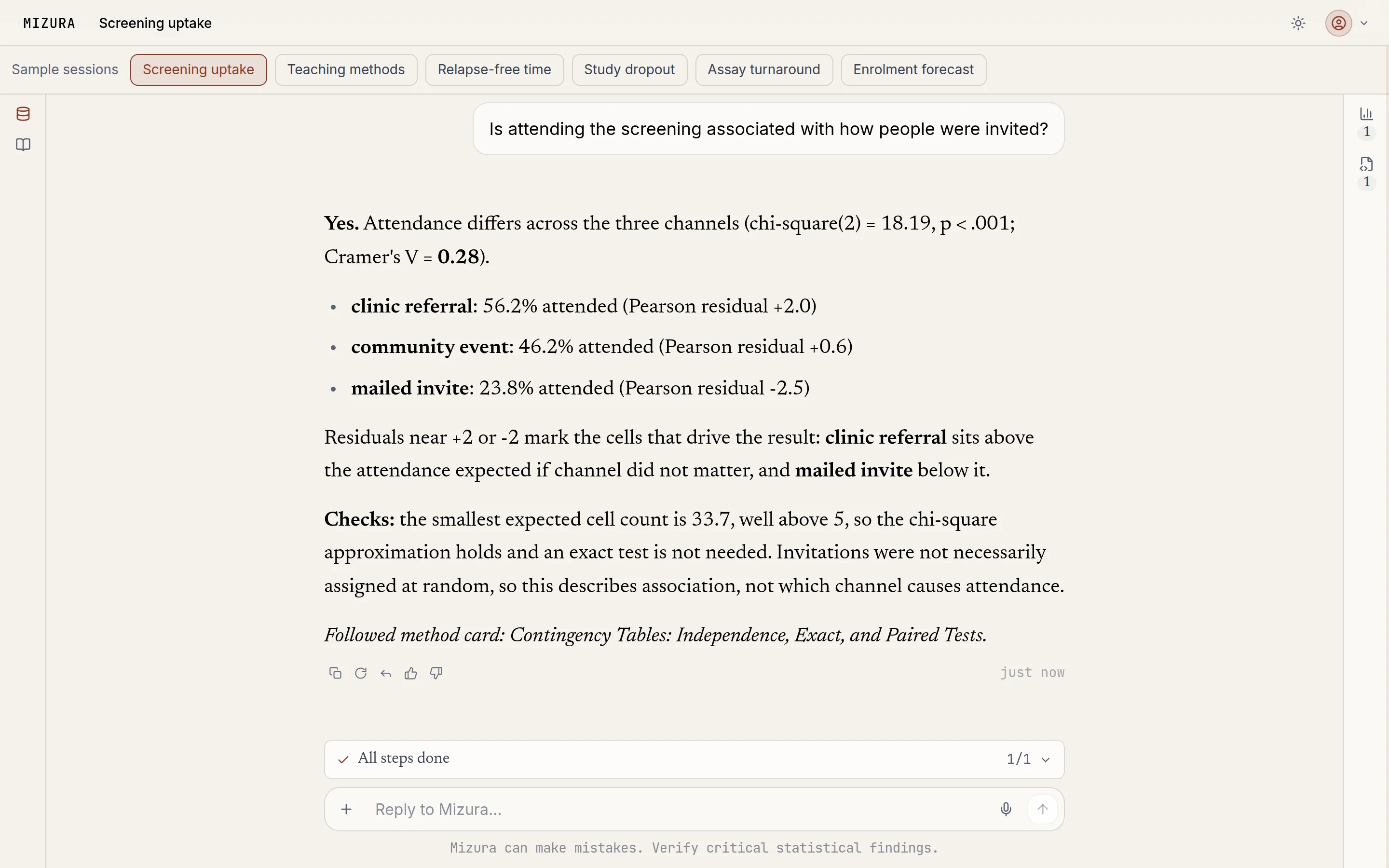
Mizura opens the matching card before it analyzes anything. Open a drawer.
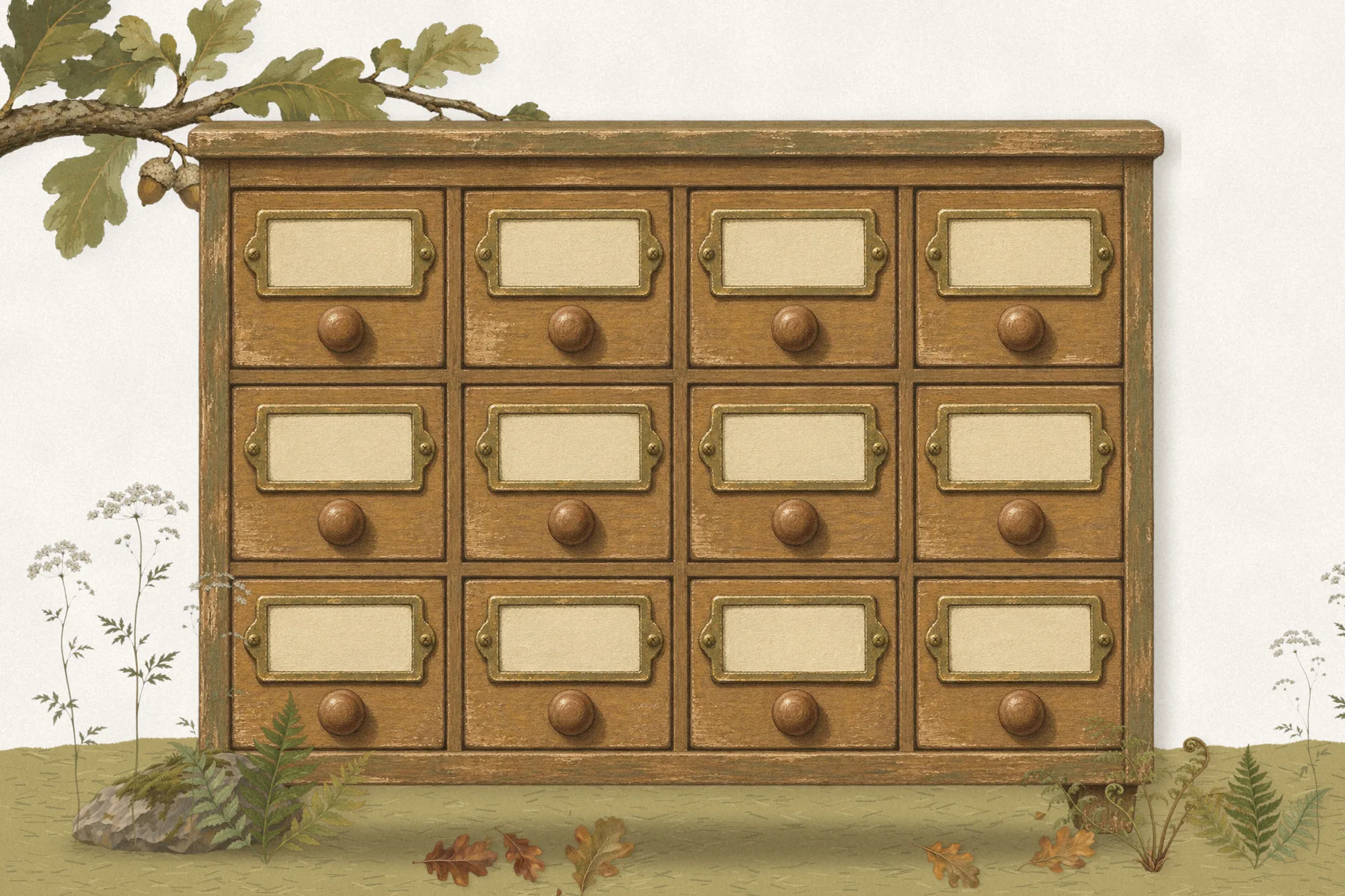
Regression 9 cards. Linear, logistic, beta, gamma, Poisson, negative binomial, Tweedie, GEE, penalized. Beta Regression, Gamma Regression, Generalized Estimating Equations, +6 more
Cite in APA 7, Harvard, Vancouver, Chicago, IEEE or MLA.
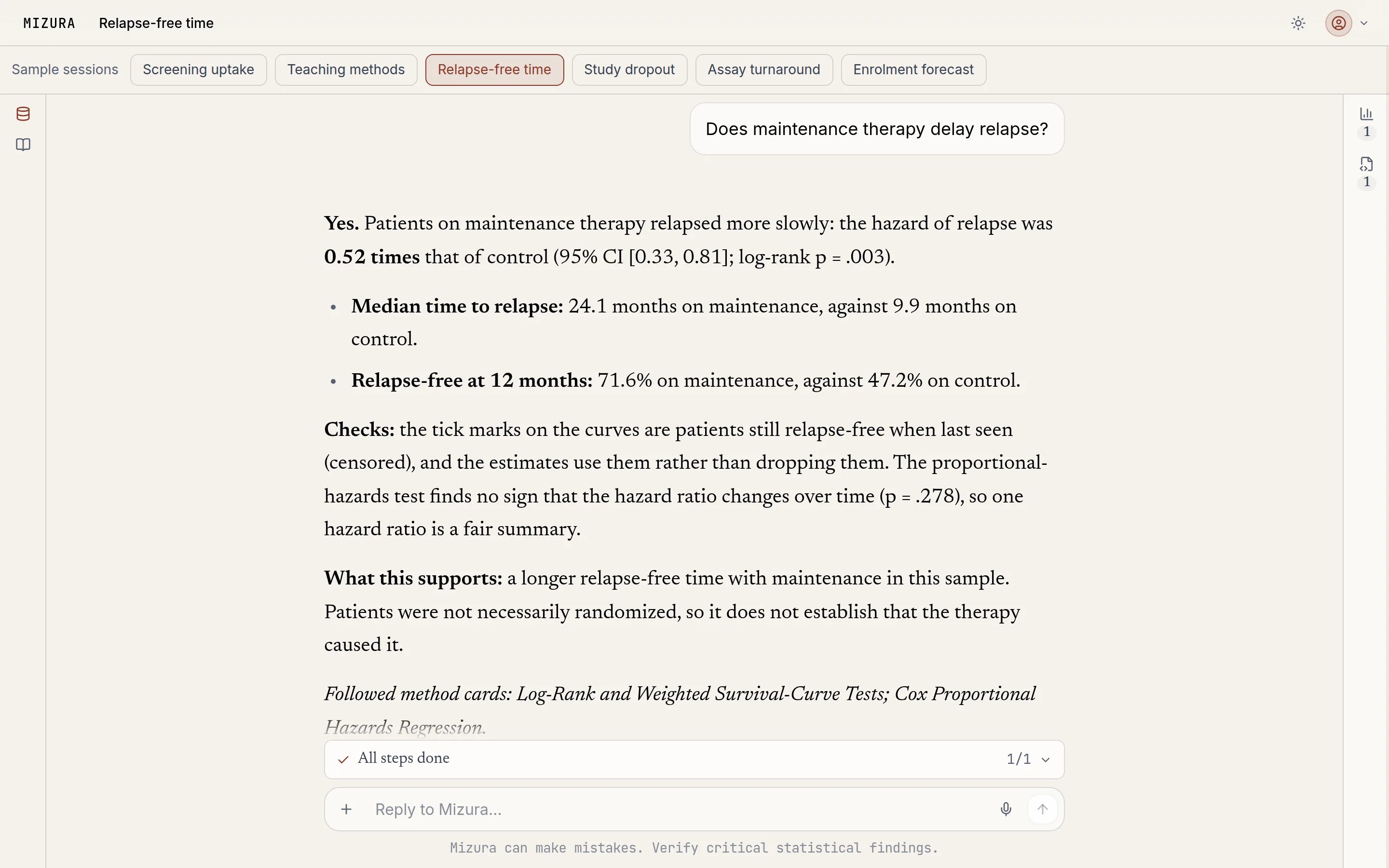
Maintenance therapy and time to relapse: a survival analysis
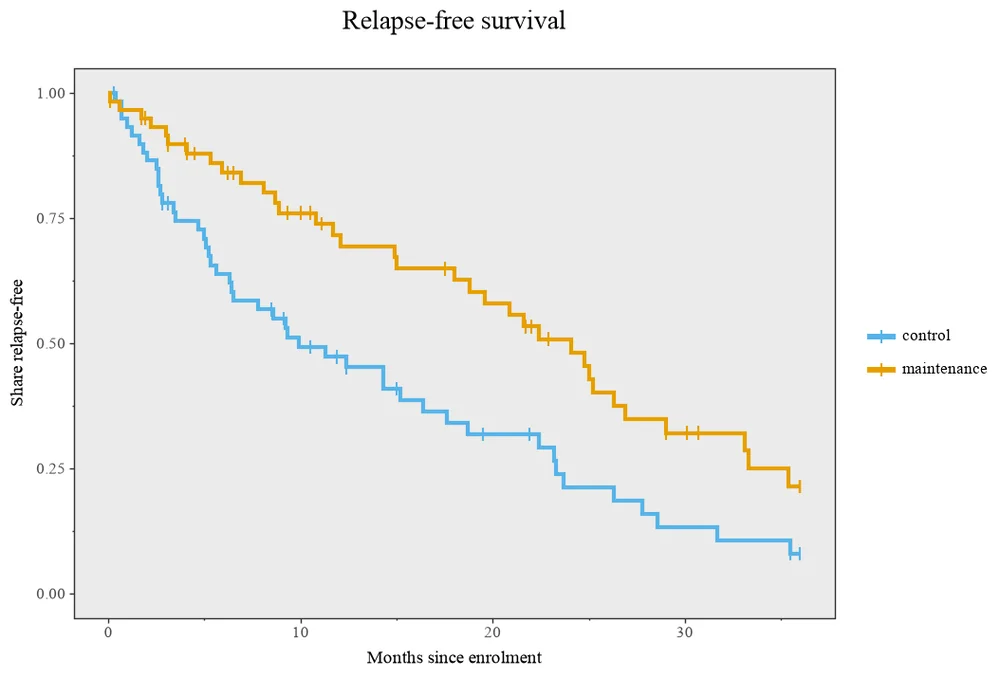
What the analysis tells us: Patients on maintenance therapy relapsed more slowly in this sample, and the difference is unlikely to be chance alone. The hazard ratio is a single summary of how much slower.
What the analysis does NOT tell us: This sample cannot show that maintenance therapy caused the longer relapse-free time, because nothing here says patients were assigned to an arm at random. The hazard ratio describes this sample only.
The same analysis, in R, Stata, SPSS or SAS. Only Python runs in Mizura; the rest is handed over as code.
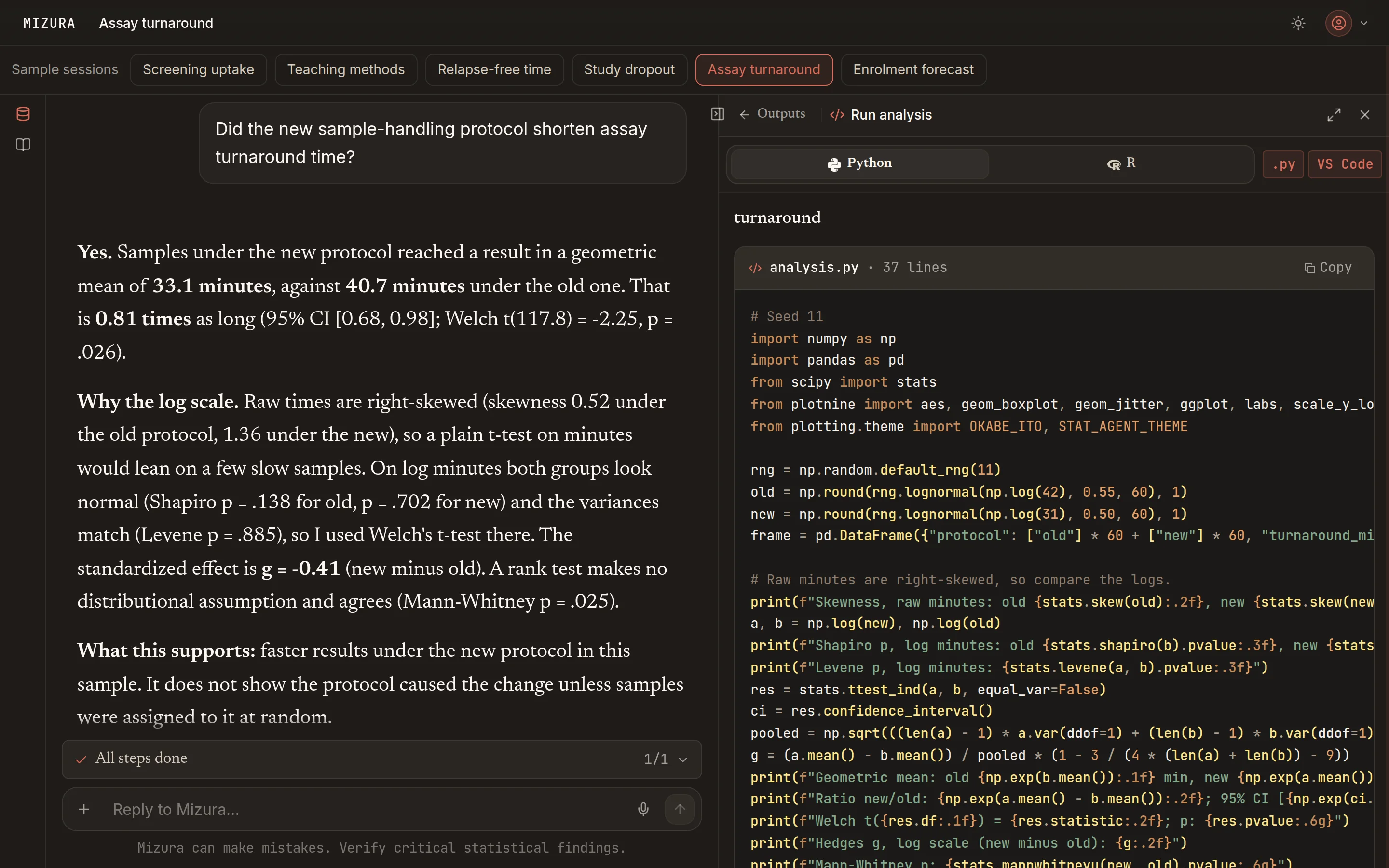
a, b = np.log(new), np.log(old)
res = stats.ttest_ind(a, b, equal_var=False)
ci = res.confidence_interval()
print(f"Ratio new/old: {np.exp(a.mean() - b.mean()):.2f}; 95% CI [{np.exp(ci.low):.2f}, {np.exp(ci.high):.2f}]")
print(f"Welch t({res.df:.1f}) = {res.statistic:.2f}; p: {res.pvalue:.6g}")
Ratio new/old: 0.81; 95% CI [0.68, 0.98]
Welch t(117.8) = -2.25; p: 0.0261709data$protocol <- factor(data$protocol, levels = c("old", "new"))
test <- t.test(log(turnaround_minutes) ~ protocol, data = data)
ratio_new_over_old <- exp(diff(test$estimate))
interval <- exp(-rev(test$conf.int))
cat(sprintf("Ratio new/old: %.2f; 95%% CI [%.2f, %.2f]\n", ratio_new_over_old, interval[1], interval[2]))
cat(sprintf("Welch t(%.1f) = %.2f; p: %.6g\n", test$parameter, -test$statistic, test$p.value))
Ratio new/old: 0.81; 95% CI [0.68, 0.98]
Welch t(117.8) = -2.25; p: 0.0261709
Your datasets, sessions, and code stay on your device. Only what a response needs is sent to Model Zero, and by default none of it is kept.
Mizura
$10 USD / month
Plus applicable taxes.
One plan for your research workflow, with AI included. No API key needed.
No. Mizura is built around statistical research: datasets, methodology, code execution, diagnostics, and reporting. Its outputs still require a researcher’s judgment.
No. Mizura works on zero data retention. We retain nothing from your prompts, datasets, or sessions, and we do not use them to train models. Sharing prompts to help improve the model is opt-in only and off by default.
Thumbs up or down on a response counts as feedback on model quality. It never shares your prompts or data by itself.
Privacy policyThe engine runs on your device. Your data, sessions, and outputs stay in a local folder on your machine, and analysis code runs locally in a sandbox. Prompts go to Model Zero to generate responses, and we retain nothing from them. Literature search contacts external services.
CSV and other delimited text, Excel, Parquet and Feather, JSON, and Stata .dta files. You can also import from GitHub, Google Drive, and Zenodo.
SPSS .sav and SAS files cannot be read as datasets. Convert them to CSV, Parquet, or .dta first.
No. Only Python executes. Mizura can write R, Stata, SPSS, or SAS code for a finished Python analysis, but it is handed over unrun. Its numbers are not results.
Every statistic in an answer must trace back to executed code. A number the code never printed goes back for correction. In a report, it blocks the document. An answer flagged for numbers is unfinished. Do not quote it.
Mizura includes 83 methodology cards in 12 families, from exploratory analysis and regression to survival analysis, econometrics, and research integrity.
All methodsYes. Every run leaves an execution record with hashes of the code, the data, and the result. Export the session as a Jupyter notebook, a Quarto document, or a replication package, and replay an execution to compare its result with the recorded hash.
Yes. Discuss an analysis in English or Arabic. Reports can be written in Arabic and typeset right-to-left. The analysis language setting also covers French, Spanish, German, Italian, and Portuguese.
Mizura is developed by Model Zero for Technological Solutions. Model Zero is also the model behind Mizura: the one your prompts are sent to when it writes a response.